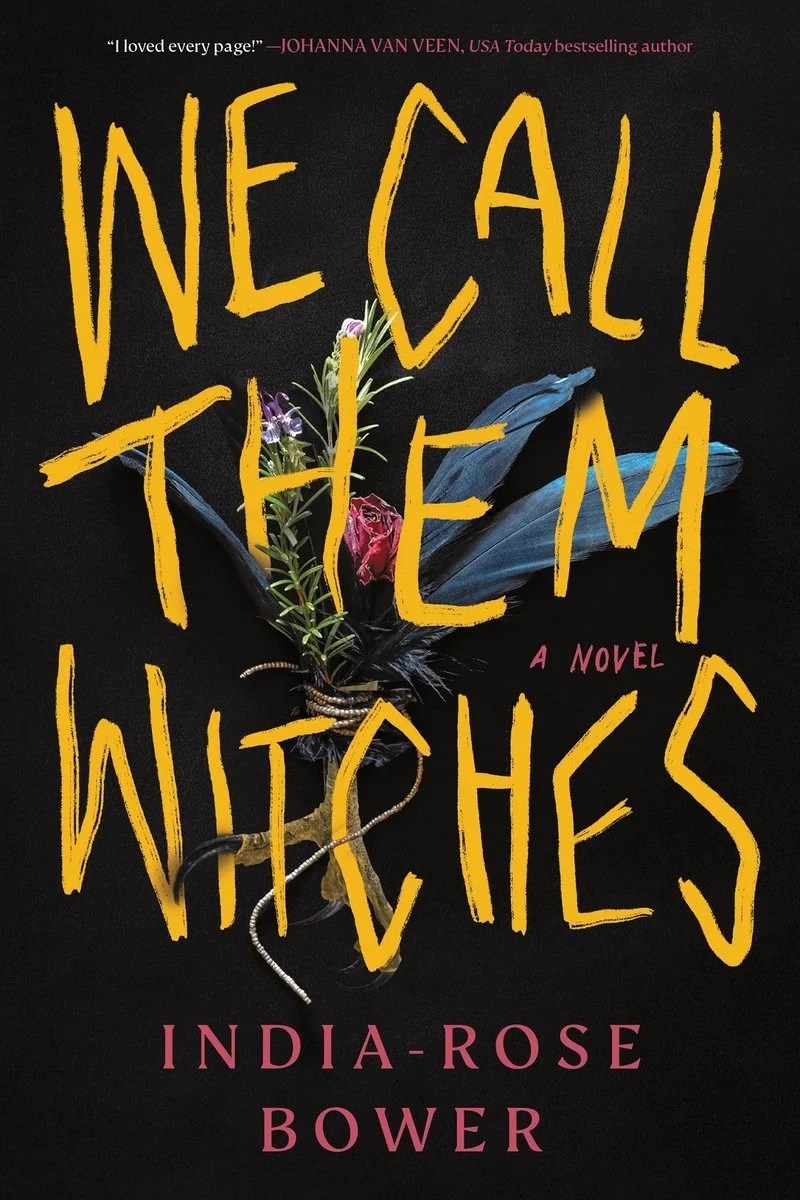
I thought I was going to read We Call Them Witches by India-Rose Bower much sooner than I did. Although I got approval for an ARC pre-publication, due to an oversight, I wasn’t able to download my copy. However, since I was still very interested in reading the book and wanted to fulfill on my offer to review it, I turned to my local library. Of course, that meant waiting until after publication day, but I had a physical copy in my hands very quickly once it was out. (Libraries are the best!) As a result, I ended up finishing on June 1st, the first day of Pride month. That felt like a fitting nod to the LGBTQIA+ representation this book has. I really enjoyed it.
We Call Them Witches is available now through all your favorite book retailers, including on Bookshop.org
Summary:
No one is really sure what the monsters are, or where they came from. One day everything was normal, but then the next, everyone was in danger. People started calling them “witches” simply to have a name to use for the entities hunting them. Sara and her family escaped the city and now live on the run, fleeing from location to location in attempts to stay alive. Her Ma has a lot of relevant knowledge gained from the folklore stories her parents used to tell her. She thought there was no truth to the tales until she needed to defend her family. Then, she was willing to try anything.
They’ve survived far longer than most, but they’ve never found safety. At least, not to any real degree. Ma and Sara, along with her older sibling Danny and Danny’s partner, do everything within their power to keep the younger siblings safe and sheltered from the horrors outside their wards. Unfortunately, soon after a strange girl appears who claims to have escaped the witches, their efforts prove insufficient. The witches steal away Sara’s younger brother. However, if this girl was able to escape from them, that means there’s a chance that they can save him too.
My Thoughts:
I know opinions differ strongly about LGBTQIA+ characters who possess large faults or who exhibit harmful traits and behaviors. More positive representation in general media would be wonderful. However, when I’m reading horror like this, perfect characters are extremely unlikely to earn either my interest or my trust. Gaining both is nearly impossible. Sara’s family have watched society collapse around them. They heard the screams as the population was decimated. Though they survived, no one can expect to endure experiences like theirs without profound mental scarring. Even the youngest and best-shielded of them can’t remain entirely unscathed. However much these characters may care for one another, they often do not treat each other well. Truthfully, I would find it far less realistic if they were always capable of doing so.
To that end, I really appreciated the ways in which Bower demonstrated the danger of this world. While all of our characters have now spent a significant amount of time surviving their world as it is, their levels of expertise vary. The family has designated roles for each individual, and some are more hands-on with their defenses than others. A person’s role has a major correlation to their coping mechanisms in moments of crisis. Readers are left to wonder whether the roles were assigned based preexisting traits or whether characters were shaped by their responsibilities.
In Sara’s role, as with most other aspects of her life, she feels stuck in the middle. She stays behind to protect those more vulnerable when those deemed more physically capable than her go on patrol or undertake missions. She has a lot of knowledge in theory, gained from her mother’s teachings, but she has never had to put most of it into practice. As a result, we see a gripping and thoroughly realistic freeze reaction in a moment of overwhelm.
I did really enjoy that the characters didn’t have all the answers. Society collapsed too quickly for broadcasts, let alone studies and publications. Sara’s family has even made a game of guessing how the witches originated or where they came from. The one rule is that no theory can become too serious. It makes for lovely moments of bonding sprinkled throughout the story. Ambiguity remains for the readers in the end as well in a way I appreciated, but some readers may feel frustrated by. Not all questions need answering to tell a story fully. Some of the open ends will inspire ongoing thought, or possibly lively discussion with other readers. This is a book that wants to stay with you long after its final page. I’ll be keeping an eye out for future publications from India-Rose Bower.
Content Warnings: Vomit, Emotional Neglect, Graphic Depictions of Violence & Injury, Kidnapping, Death of Parent, Deadnaming & Misgendering, Body Horror, Child Death, Blood, Dismemberment & Mutilation, Rot & Decomposition (Including Insects), Cannibalism, Parentification
After I Finished We Call Them Witches
This coming week, I will be introducing an author at a speaking event. He will be presenting and answering questions on his most recent book, Matisse at War, which I was happy to review an ARC of. I really enjoyed the book and have enthusiastically shared it with other readers at every opportunity. In fact, I had a large hand in organizing this event. However, this author had published a book prior that I had yet to read. The book had been sitting on my shelf waiting patiently for me, and it was finally time.
My next review will be for The Confidante by Christopher C. Gorham.
Subscribe to the Newsletter
Stay in the loop by signing up to get all the latest updates sent straight to your inbox.

Leave a Reply